
Since 2007, HIDALGO Sattel creates handcrafted saddles ensuring comfort, style, and lasting innovation.
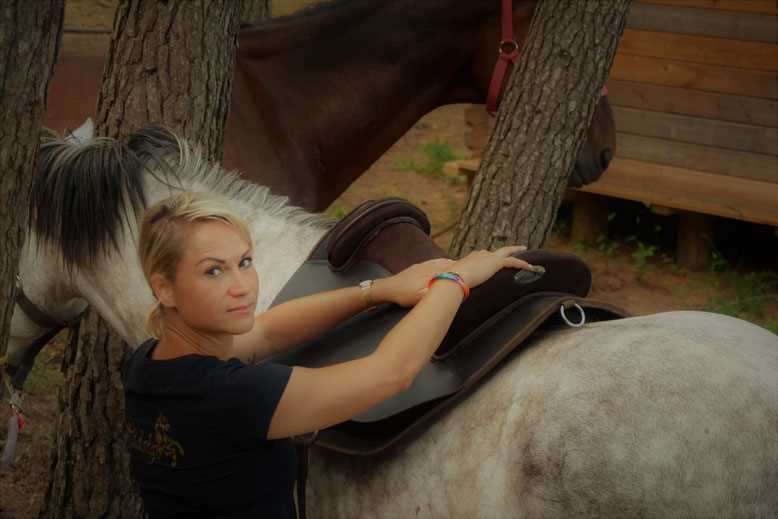
HIDALGO: Let’s go through the leather tree saddle layer by layer: How does a leather tree saddle differ from a traditional tree saddle?
The inside of a traditional tree saddle consists of a wooden or solid plastic tree. This is form-stable and usually not really flexible in the longitudinal or transverse axis. The leather tree, as the name suggests, is made of leather. Hardened leather is also form-stable but adapts through various factors like body heat and movement. This means the tree moves in both the longitudinal and transverse axes, and with each movement, it adjusts three-dimensionally, molding perfectly to the horse’s back over time.
What is the difference between a leather tree and a treeless saddle?
In a treeless saddle, there is no tree inside at all. These saddles are usually made of layered foam materials. They often sit rather “soft” and wide, which is not the case with the leather tree.
Can I do everything with a leather tree saddle, just like with any other traditional tree saddle? Long rides? Jumping? Or are there limits?
Definitely YES, EVERYTHING! You can do everything with a leather tree saddle. Especially, the aids come through more clearly and faster to the horse, and the horse moves much more freely because there’s no rigid tree and head iron restricting the movements. We have successfully tested our leather tree saddles on numerous trails, some even through mountains.
People often have respect for flexible trees because they’re afraid of creating pressure peaks while riding: Are there pressure measurements for your leather tree saddles? If so, what are the results?
Yes, that’s true. These prejudices are heard quite often. We have colleagues who check saddle fits using thermography, and it was found that the leather tree distributes pressure much more evenly than a traditional tree saddle. Also, the spinal channel in most traditional tree saddles is simply too narrow, which can cause issues for the horse, as the panels often press directly on the spinous processes and the spine.
There’s occasional criticism that leather tree saddles bend too much in the middle due to the rider’s weight – what do pressure measurements say about this?
As mentioned, the pressure measurement in a leather tree saddle was clearly better than in a traditional tree saddle. I haven’t encountered any issues with bending in the middle. We don’t know of any Hidalgo saddle that causes problems there.
Are there anatomical limits? For example, can it also work for a horse with a high withers?
It always depends a bit on the rider’s budget and the model series of the Hidalgo saddles, but in the special series from Hidalgo, there are no limits. Even horses with very short backs and high withers are not a problem.
What about horse breeds with special requirements, such as Icelandic horses or cold-blooded breeds?
These horses are generally not a problem either. As long as the horse and rider harmonize reasonably well, and the budget fits the situation, an appropriate solution can always be found. Especially in difficult cases, we are often the last resort, where things finally work out.
So, does the leather tree saddle fit every horse, or are there certain types of horses or backs where it’s not suitable?
We haven’t encountered any horse type that we couldn’t saddle.
What about the riders – is there a weight limit?
The saddle offers enough adjustment options to accommodate heavier riders. For example, you can order the panels with felt reinforcement, or the leather tree itself is partially reinforced with felt. The weight limit is more determined by the muscle structure and build of the horse.
Expressed in percentages: If a well-fitting wooden tree saddle provides 100% pressure protection, how much protection does the leather tree saddle provide?
Since we believe a well-fitting wooden tree saddle can’t provide 100% protection, because it can’t move with the horse, a well-fitted (to horse and rider!) Hidalgo saddle definitely provides much better pressure protection, as long as the rider is riding well. No saddle tree can completely compensate or absorb a poorly fitting, crooked, or unbalanced rider.
How can I tell if my leather tree saddle fits my horse and isn’t causing pressure?
By having it checked by a trained saddle fitter, regularly checking the horse’s back (or having it checked by an osteopath/physiotherapist), and listening to my horse while it’s moving. In most cases, horses clearly show when something isn’t sitting 100% and needs to be re-adjusted.
The leather tree is flexible, but it still needs to be adjusted, right?
Exactly, a leather tree (and also a treeless) saddle needs to be adjusted and checked just like any other saddle. Of course, the customer can, with a bit of skill, make some adjustments themselves on our saddles, thanks to the removable saddle panels, which isn’t possible with a traditional tree saddle.
How exactly is the saddle adjusted to the horse – what points or body areas are considered during the adjustment, and what parameters are there?
For a leather tree saddle, the same points are important as with a traditional saddle. The difference is that we don’t need to measure the gullet width in the traditional sense because the Hidalgo leather tree works without a head iron.
We first need to know the contact area of the horse’s back. We look at the horse’s shoulder and measure from behind the shoulder to the last rib. Then, we need the width of the spinal channel. We carefully examine the horse’s back and spine, looking at where the spinous processes start and end and where the long back muscle runs. This muscle is the one that can actually carry our weight. This means the panels need to rest here without compressing the spinous processes. We also look at where and how the girth placement runs. Based on this, and depending on how much space the shoulder needs, we know where to place the panels under the saddle.
Do I need to change the saddle if my horse gains or loses weight? Summer/Winter – Healthy and sick phases?
No, that’s the beauty of the leather tree saddle. They adapt and can always be re-adjusted to new conditions.
What makes Hidalgo leather tree saddles different from other leather tree saddles?
The quality of the leather, the fit, years of continuous model refinement (we’ve been on the market since 2007!), the flexible adjustment and ordering options, the great selection of different models, and the wide range of customization possibilities.
Why did you decide to make leather tree saddles?
Because of the variety of possibilities and the ability to continuously adjust the saddles. Not least to help many, sometimes truly desperate, horse-rider pairs with a convincing system.
How do you ensure your saddles don’t cause pressure?
By regularly conducting pressure tests, constantly checking the saddles, and asking for suggestions for improvements. Of course, we can’t address specific cases here, as every horse is different and every rider rides differently. Pressure, in particular, is a topic that should be addressed individually.
Specifically, because they need to be broken in – what does that mean (how long, how often, how much), and how does the “new saddle” feel compared to a broken-in one?
Breaking in takes about 30 intense rides.
The “new saddle” is often described by my customers as feeling a bit distant from the horse and “perched.” But this feeling usually disappears after 3-4 rides, and with each ride, the rider gets closer to the horse and better seated. The leg position forms, and the saddle becomes like a “couch.”
Is it difficult if you want to use it, for example, on a young horse?
For test rides on a young horse, I always use well-broken-in test saddles. But of course, you can also use a new leather tree saddle on a young horse. It can be readjusted with every change. That’s the great thing about the system. It may take a bit longer to break in a saddle on a young horse, but with this saddle, I have something that can last a lifetime and can be adjusted as needed. With a traditional tree saddle, you would probably have to buy a new one every six months.
At which points can I adjust your saddle to fit the horse? (Tree? Head iron? Padding? – how exactly and more?)
Since we don’t have a head iron in our saddles, that’s not an issue. The “gullet” adapts automatically. The tree also adapts on its own, but for very wide horses, there’s the option to order the saddle, or more precisely, the shaping element in the area of the stirrup bar, wider. The panels are the main part of the adjustment. These come in different lengths, shapes, thicknesses, materials/fillings, etc. And of course, the seat size of the saddle has to fit both the horse and rider.
How long have you been around, and how and why did you develop your saddles?
Hidalgo has been around since 2007 and has constantly grown. The company was founded for one simple reason: …to finally find a saddle that fits.